Imagine conducting a symphony orchestra, each musician playing with impeccable precision—modern commercial brewery equipment achieves this synergy, seamlessly blending massive production volume with refined quality. A complete commercial brewing system, such as a 10,000-liter mashing and boiling system, can process tons of raw materials in a single production cycle, reducing traditional brewing time from weeks to approximately 14 days. Its core lies in the integrated automated control model, which precisely controls mashing temperature fluctuations within ±0.5°C, ensuring a stable starch conversion efficiency of over 95%, directly driving annual production growth of 20% to 30%. Industry giants like Anheuser-Busch InBev, through their globally distributed smart factories, ensure that the original wort concentration error for each batch of beer is less than 0.1% through standardized equipment parameters—the cornerstone of consistent quality in large-scale production.
In the technological arena of ensuring flavor consistency, commercial brewing equipment plays the role of a "quality gatekeeper." Advanced fermentation tanks, equipped with a multi-point temperature and pressure sensor network, enable gradient temperature control of 100,000 liters of liquid within the tank, with a temperature difference not exceeding ±0.3°C. This maintains yeast activity within its optimal range and reduces the probability of flavor byproduct formation by 15%. Studies show that breweries using high-precision centrifuges and filtration systems can maintain beer turbidity below 0.5 EBC for extended periods, extending flavor stability by 30%. For example, Heineken's optical inspection and automated adjustment system, used in its global production lines, monitors multiple parameters such as color and carbon dioxide concentration in real time for each bottle of beer. Products with deviations exceeding preset ranges (e.g., ±2%) are automatically rejected. This quality control solution has reduced customer complaint rates by nearly 40%.
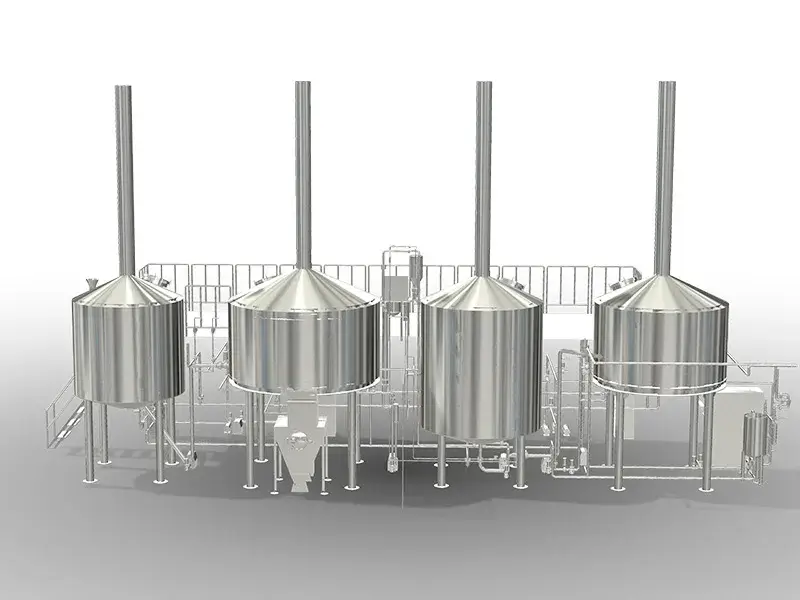 From an economic perspective, high-efficiency commercial brewing equipment directly improves profit margins by optimizing energy and material consumption. A boiling kettle system integrating heat recovery technology can recover up to 85% of waste steam heat for preheating brewing water. This innovation can save a brewery with an annual production capacity of 100,000 kiloliters approximately 15% of its energy costs annually. For example, a mid-sized craft brewery in the United States upgraded its piping and fermentation tanks with Clean In-Place (CIP) technology in 2022. This resulted in a 50% reduction in cleaning water consumption, a 30% decrease in cleaning agent costs, and an 18% increase in effective production time. The return on investment was projected to be only 22 months. This refined management of resources and budgets is one of the core benefits of modern commercial brewing equipment.
Ultimately, the key to achieving a balance between scale and quality lies in data integration and intelligent analysis. Modern commercial brewing equipment forms an Industrial Internet of Things (IIoT) platform. Sensors collect over 200 parameters, including temperature, pressure, flow rate, and density, several times per second, creating a massive data stream. Regression analysis of this data using machine learning algorithms can predict equipment maintenance cycles, reduce unplanned downtime by 60%, and improve the accuracy of production planning to 98%. As Carlsberg disclosed in its "Together Towards Zero" sustainability strategy, by optimizing its production processes through equipment networking, it achieved an industry-leading reduction in water consumption per hectoliter of beer to 2.6 hectoliters in 2023. All of this proves that modern commercial brewing equipment has transcended the category of a single production tool. It is a manufacturing ecosystem that integrates intelligent control, resource optimization, and risk management, ensuring that at peak production levels, the standard deviation of the sensory characteristics of each bottle of beer is infinitely close to zero.
From an economic perspective, high-efficiency commercial brewing equipment directly improves profit margins by optimizing energy and material consumption. A boiling kettle system integrating heat recovery technology can recover up to 85% of waste steam heat for preheating brewing water. This innovation can save a brewery with an annual production capacity of 100,000 kiloliters approximately 15% of its energy costs annually. For example, a mid-sized craft brewery in the United States upgraded its piping and fermentation tanks with Clean In-Place (CIP) technology in 2022. This resulted in a 50% reduction in cleaning water consumption, a 30% decrease in cleaning agent costs, and an 18% increase in effective production time. The return on investment was projected to be only 22 months. This refined management of resources and budgets is one of the core benefits of modern commercial brewing equipment.
Ultimately, the key to achieving a balance between scale and quality lies in data integration and intelligent analysis. Modern commercial brewing equipment forms an Industrial Internet of Things (IIoT) platform. Sensors collect over 200 parameters, including temperature, pressure, flow rate, and density, several times per second, creating a massive data stream. Regression analysis of this data using machine learning algorithms can predict equipment maintenance cycles, reduce unplanned downtime by 60%, and improve the accuracy of production planning to 98%. As Carlsberg disclosed in its "Together Towards Zero" sustainability strategy, by optimizing its production processes through equipment networking, it achieved an industry-leading reduction in water consumption per hectoliter of beer to 2.6 hectoliters in 2023. All of this proves that modern commercial brewing equipment has transcended the category of a single production tool. It is a manufacturing ecosystem that integrates intelligent control, resource optimization, and risk management, ensuring that at peak production levels, the standard deviation of the sensory characteristics of each bottle of beer is infinitely close to zero.
From an economic perspective, high-efficiency commercial brewing equipment directly improves profit margins by optimizing energy and material consumption. A boiling kettle system integrating heat recovery technology can recover up to 85% of waste steam heat for preheating brewing water. This innovation can save a brewery with an annual production capacity of 100,000 kiloliters approximately 15% of its energy costs annually. For example, a mid-sized craft brewery in the United States upgraded its piping and fermentation tanks with Clean In-Place (CIP) technology in 2022. This resulted in a 50% reduction in cleaning water consumption, a 30% decrease in cleaning agent costs, and an 18% increase in effective production time. The return on investment was projected to be only 22 months. This refined management of resources and budgets is one of the core benefits of modern commercial brewing equipment.
Ultimately, the key to achieving a balance between scale and quality lies in data integration and intelligent analysis. Modern commercial brewing equipment forms an Industrial Internet of Things (IIoT) platform. Sensors collect over 200 parameters, including temperature, pressure, flow rate, and density, several times per second, creating a massive data stream. Regression analysis of this data using machine learning algorithms can predict equipment maintenance cycles, reduce unplanned downtime by 60%, and improve the accuracy of production planning to 98%. As Carlsberg disclosed in its "Together Towards Zero" sustainability strategy, by optimizing its production processes through equipment networking, it achieved an industry-leading reduction in water consumption per hectoliter of beer to 2.6 hectoliters in 2023. All of this proves that modern commercial brewing equipment has transcended the category of a single production tool. It is a manufacturing ecosystem that integrates intelligent control, resource optimization, and risk management, ensuring that at peak production levels, the standard deviation of the sensory characteristics of each bottle of beer is infinitely close to zero.