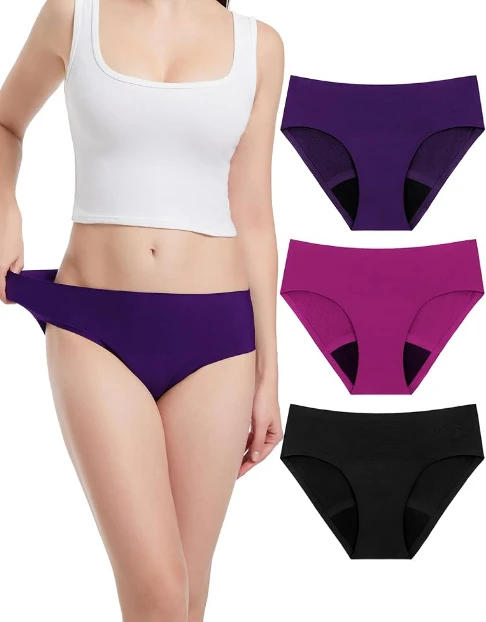
Yes, period panties can replace pads and tampons for many people, but not in every situation. The deciding points are flow, absorbency, fit, wear time, laundry access, and the type of activity. A 2023 study testing 21 menstrual products with packed red blood cells found period underwear averaged about 2 mL before saturation under the study conditions, showing that published “tampon-equivalent” claims are not directly comparable to blood-based testing. For light or moderate flow, properly fitted period panties can be used alone. Heavy bleeding, swimming, long days away from home, or frequent saturation may require another product or more frequent changes.
Period panties use an absorbent gusset built into underwear rather than a separate disposable pad or an internal tampon. The design normally combines a moisture-contact layer, an absorbent layer, and a leak-resistant barrier, although construction varies by manufacturer.
The first issue is capacity. A 2026 cross-brand review found that products labeled “Heavy” ranged from about 20 mL to 63 mL depending on the brand, a difference of more than 200% between the lowest and highest figures in that comparison. That spread makes the word “heavy” less useful than an actual milliliter figure.
A label such as “4 tampons” is not a universal measurement. FDA tampon absorbency classes themselves cover different ranges: light is up to 6 g, regular is more than 6 g to 9 g, super is more than 9 g to 12 g, super plus is more than 12 g to 15 g, and ultra is more than 15 g to 18 g.
This explains why two products with similar marketing language can perform very differently. In 2026, published claims from different brands still used different tampon-equivalent references, while some provided milliliter values; comparing products by the same unit is more reliable than comparing the number of tampons claimed.
The 2023 blood-based study adds another layer. Researchers from Oregon Health & Science University tested 21 menstrual products using packed red blood cells rather than only saline or water. Menstrual underwear averaged about 2 mL of absorbed red blood cells in the study, while a menstrual disc averaged 61 mL and reached as high as 80 mL for the tested product.
That result should not be read as saying every pair of period underwear holds only 2 mL in everyday use. The study measured a specific laboratory setup, and absorbency can differ with fabric, pressure, liquid composition, fit, and product construction. It does show why real menstrual blood and synthetic test fluid should not be treated as identical.
For pad users, the transition can be fairly simple because both products collect fluid outside the vagina. The main differences are washing, changing the entire garment, and the way the absorbent panel sits against the body.
ACOG states that period underwear can be worn for a full day depending on the underwear and the user's flow, while also noting that some people may need to change sooner. Pads are generally changed at least every 4 to 8 hours or when they feel full, wet, or uncomfortable.
For tampon users, the change is larger because a tampon absorbs menstrual fluid inside the vagina. The FDA considers tampons safe when used according to instructions and advises changing them every 4 to 8 hours, with no tampon worn longer than 8 hours. Period underwear removes the need for an inserted product, which can matter to people who dislike internal products or prefer external protection.
The practical advantage is not that period underwear never needs changing; it is that the change involves replacing a washable garment rather than disposing of another single-use product.
Heavy flow needs more planning. ACOG lists soaking through one or more pads or tampons every hour for several hours as a sign of heavy menstrual bleeding, and bleeding lasting more than 7 days can also warrant medical evaluation. In that situation, choosing increasingly absorbent underwear without considering the underlying bleeding pattern may not solve the real problem.
| Situation | Period panties alone | Pads | Tampons |
|---|---|---|---|
| Light flow | Often suitable | Suitable | Suitable |
| Moderate flow | Often suitable with correct capacity | Suitable | Suitable |
| Heavy flow | May require frequent changes or backup | May require frequent changes | May require frequent changes |
| Overnight | Often convenient | Common option | Requires 4–8 hour changes |
| Swimming | Standard styles are unsuitable | Unsuitable | Suitable |
| No laundry access | Less convenient | Convenient | Convenient |
Overnight use is one area where period panties can be practical. A wider absorbent panel can reduce the chance of fluid reaching the back edge while sleeping, and there is no adhesive pad that can move separately from the underwear.
Still, the 2023 study found that increasing the size of period underwear did not significantly increase absorbed red blood cell volume under its test conditions. A larger cut therefore should not automatically be treated as a higher-capacity product.
Fit also affects leakage. The absorbent area needs to stay close to the body, especially around the leg openings and back panel. Underwear that is too loose can create gaps, while excessively tight garments may become uncomfortable over several hours.
Washing is part of the product's performance. Reusable underwear needs access to water, detergent, and enough time to dry completely. A 2021 Life Cycle Initiative review noted that the environmental performance of reusable menstrual products depends substantially on user behavior, including washing practices and energy use.
The environmental comparison is generally favorable to reusable products when they are used for a reasonable service life. A 2022 life-cycle assessment compared pads, tampons, menstrual cups, reusable pads, and menstrual underwear across France, India, and the United States over one year. Menstrual underwear ranked among the lower-impact options, although the exact result changed with country and use assumptions.
A UK study published in 2022 estimated annual menstrual-management waste at 28,114 tonnes and found that replacing disposable products with reusable alternatives could reduce waste by about 22,907 tonnes per year, with an estimated reduction of around 7,900 tonnes of CO₂-equivalent emissions.
Those figures do not make reusable underwear impact-free. Laundering uses water and electricity, and manufacturing textiles also has an environmental cost. The 2021 review specifically noted that period underwear can have lower impacts than single-use options when it is washed in an energy-efficient way.
Material disclosure also deserves attention. In 2021, a Mamavation investigation reported fluorine in 65% of 17 tested period-underwear products, using fluorine as a screening marker rather than proof that each product contained a particular PFAS compound. That test was not a survey of the entire market, and brands have since changed materials and formulations.
Current product information therefore matters more than relying on an old percentage. In 2026, some manufacturers publish third-party testing or PFAS statements, while others provide limited chemical information. Buyers comparing products should look for actual test documentation rather than treating “PFAS-free” as a generic feature across the whole category.
For cost, the calculation depends on how many pairs are needed and how long they last. Someone using one pair only on light-flow days may replace very little. Someone using reusable underwear as the main product for several cycles may purchase 4–8 pairs to cover changes during a typical period while allowing time for washing and drying.
Tampons have a different replacement schedule because the FDA recommends a new tampon every 4–8 hours. Period underwear does not require a disposable replacement on that schedule, but the garment still needs to be changed when saturated or uncomfortable.
A mixed routine often solves practical problems without requiring complete replacement. Period panties can provide external leak protection while a tampon or menstrual cup handles the main flow, particularly during heavier days, travel, work shifts, or situations where a restroom change is inconvenient.
A person whose period normally lasts 5–7 days may use period underwear alone on lighter days, switch to a higher-capacity pair during moderate flow, and add another menstrual product when bleeding becomes unusually heavy.
Swimming remains a clear exception. Standard period underwear is underwear, not waterproof swimwear, so it is not a substitute for a tampon or another product designed for use in water. This is a product-design issue rather than a question of absorbency.
Finally, unusually heavy bleeding should not be managed only by buying higher-capacity menstrual products. ACOG advises medical evaluation when bleeding requires pad or tampon changes every 1–2 hours, lasts longer than 7 days, or is accompanied by dizziness or faintness.
For ordinary light-to-moderate periods, period panties can function as a primary product rather than a backup. For heavy flow, swimming, limited laundry access, or long periods away from home, pads, tampons, cups, or discs may still have a practical role alongside them.